
10 Best Free Coding Courses for Kids
Author: Rocket Tech School
Publication date: 15.04.2026 | Review date: 15.04.2026
Today, it is much easier for parents to introduce a child to coding than it was ten years ago. There are dozens of websites, apps, and games where they can try themselves as a developer for free. It’s important to understand which resources are truly educational and which only provide a surface-level introduction.
In this article, we’ll look at how to choose the right learning format, which online courses work best for younger and older students, and how free materials can help you decide if your child needs a more serious coding course.
In this article, we’ll look at how to choose the right learning format, which online courses work best for younger and older students, and how free materials can help you decide if your child needs a more serious coding course.
How to Choose a Free Coding Course for Your Child
Broadly speaking, all platforms can be divided into two types: gamified services with tasks and full-scale courses with a curriculum and projects. To choose the right one, it's best to first evaluate the child’s age, interests, and skill level.
Age and Skill Level
For younger students, services that use visual blocks are ideal. They don't require knowledge of complex terminology, and the child learns through play. These resources are often used by schools and clubs to start from scratch.
Teens are more interested in platforms with text-based code and real programming languages. Here, they encounter Python, JavaScript, and sometimes HTML/CSS projects. For this group, high school courses work well, providing more theory, homework, and final projects.
Remember: if a child finds tasks too easy, you can smoothly move to more advanced coding courses. If they struggle, it’s worth returning to simpler programs to give them time to adjust.
Teens are more interested in platforms with text-based code and real programming languages. Here, they encounter Python, JavaScript, and sometimes HTML/CSS projects. For this group, high school courses work well, providing more theory, homework, and final projects.
Remember: if a child finds tasks too easy, you can smoothly move to more advanced coding courses. If they struggle, it’s worth returning to simpler programs to give them time to adjust.
The Child’s Interests
Even the best-designed coding course won't work if it doesn't align with what your child likes. Some love games, while others prefer drawing or building.
Some platforms focus on visual storytelling: kids control characters, solve puzzles, and complete levels. These formats are great for keeping children engaged and motivated. Other resources are more focused on web development: students create pages with HTML, style them with CSS, and see the results instantly.
If your child is interested in design, check out free online courses on layout and interfaces. For those who love math and puzzles, services with logic and algorithm tasks are a better fit. When the direction matches their interests, children stay focused much longer.
Some platforms focus on visual storytelling: kids control characters, solve puzzles, and complete levels. These formats are great for keeping children engaged and motivated. Other resources are more focused on web development: students create pages with HTML, style them with CSS, and see the results instantly.
If your child is interested in design, check out free online courses on layout and interfaces. For those who love math and puzzles, services with logic and algorithm tasks are a better fit. When the direction matches their interests, children stay focused much longer.
Learning Format and Delivery
Before starting, look at the first few lessons to see how the material is explained. Pay attention to:
- Clear, short explanations before tasks;
- The ability to learn at their own pace;
- User interface: is it easy for a child to navigate?
- Presence of mini-projects rather than just tests.
Free Platforms for Teaching Kids to Code
Let’s look at specific resources. All of them are great for beginners and help you start learning with free materials before deciding on paid classes.
Free Trial Lesson at Rocket Tech School
If you want live interaction rather than just a website, you can sign up for a free trial lesson.
The RTS free trial is a 1-on-1 session with a teacher. The instructor adapts to the child's level, shows the basics of their chosen direction, and answers the parents' questions. This format helps you understand if your child is comfortable with online learning and a personalized approach.
The RTS free trial is a 1-on-1 session with a teacher. The instructor adapts to the child's level, shows the basics of their chosen direction, and answers the parents' questions. This format helps you understand if your child is comfortable with online learning and a personalized approach.
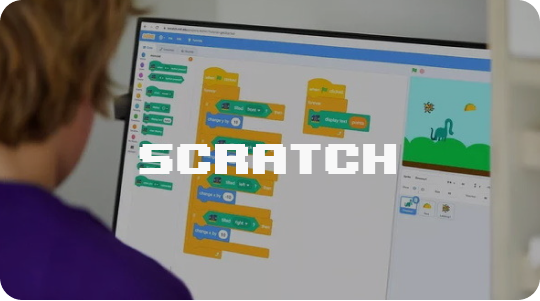
Scratch as a Starting Environment
Scratch is one of the most popular options. Everything is built on visual blocks: kids drag and drop commands to control characters. Why it’s popular:
- Kids can start coding from the simplest level;
- Projects are saved in a personal account to show friends;
- A massive global community shares ideas and ready-made projects.
Code.org: Learning Through Games and Tasks
Code.org is a large platform where learning is built around bite-sized lessons. Projects feature familiar characters, and tasks feel like game levels. Features:
- "Hour of Code" campaigns for a quick start;
- Courses for different ages, including elementary school;
- "Unplugged" activities that don't even require a computer.
CodeCombat: Gamified Programming
CodeCombat introduces text-based coding within an adventure game. The hero moves through a dungeon based on the commands the child writes. This format:
- Provides practice in Python or JavaScript;
- Teaches proper syntax;
- Reinforces skills through a storyline and missions.
FreeCodeCamp: Courses for Teens and Web Development
FreeCodeCamp is better suited for older kids. It offers long tracks on web development, from HTML basics to complex JavaScript apps. Advantages:
- Real projects for a portfolio;
- Large English-speaking community;
- A clear structure broken down into small steps.
LightBot and Logic-Based Games
LightBot and similar apps focus on logic. You have to guide a robot across a field using a limited set of commands and loops. These resources:
- Train algorithmic thinking;
- Work well even for kids who aren't yet "into" computers;
- Serve as a great supplement to any course.
Comparison of Free Coding Courses
To help you choose, here is a table comparing these services by age, format, and outcome.

Frequently Asked Questions
At what age can a child start coding?
Usually 7–8 years old, but it depends on the child. The main thing is that they can read and show interest.
Are free resources enough?
Yes, for the introductory stage. They help you explore different directions. Later, you can add paid classes for mentorship and portfolio building.
Is English required?
Many platforms are translated, but programming languages themselves use English. Children naturally pick up the basic vocabulary as they go.
Can you start from absolute zero?
Yes, most of these services are designed specifically for those who have never written code before.
What does coding give a child in the long run?
Even if they don't become a developer, coding develops logic, focus, and planning skills. Free resources allow them to try the role of a developer without financial risk.
Usually 7–8 years old, but it depends on the child. The main thing is that they can read and show interest.
Are free resources enough?
Yes, for the introductory stage. They help you explore different directions. Later, you can add paid classes for mentorship and portfolio building.
Is English required?
Many platforms are translated, but programming languages themselves use English. Children naturally pick up the basic vocabulary as they go.
Can you start from absolute zero?
Yes, most of these services are designed specifically for those who have never written code before.
What does coding give a child in the long run?
Even if they don't become a developer, coding develops logic, focus, and planning skills. Free resources allow them to try the role of a developer without financial risk.
What else is useful to read:
Programming, game development, digital creativity, and AI — choose an IT track that fits your child's age and interests!
6 courses to choose from: from animation to neural networks





Другие курсы


Rocket Tech School LLC (USA)
Rocket Tech School LLP (UK)
IE Ivan Pavliulin
2026
Rocket Tech School LLP (UK)
IE Ivan Pavliulin
2026